
Losing a tooth can affect more than the appearance of your smile. Missing teeth can make chewing more difficult, affect how you speak, and create changes in the surrounding teeth and jawbone over time. Fortunately, several tooth-replacement options are available, including removable dentures and dental implants.
Both options can restore missing teeth, but they work in very different ways. Dentures rest on the gums and can be removed, while dental implants are anchored into the jawbone to support a replacement tooth or dental prosthesis. This difference can affect stability, comfort, oral function, maintenance, and long-term treatment considerations.
Dental Implants vs. Dentures: Understanding the Difference
Before comparing the benefits, it helps to understand how each option replaces missing teeth.
How Dental Implants Work
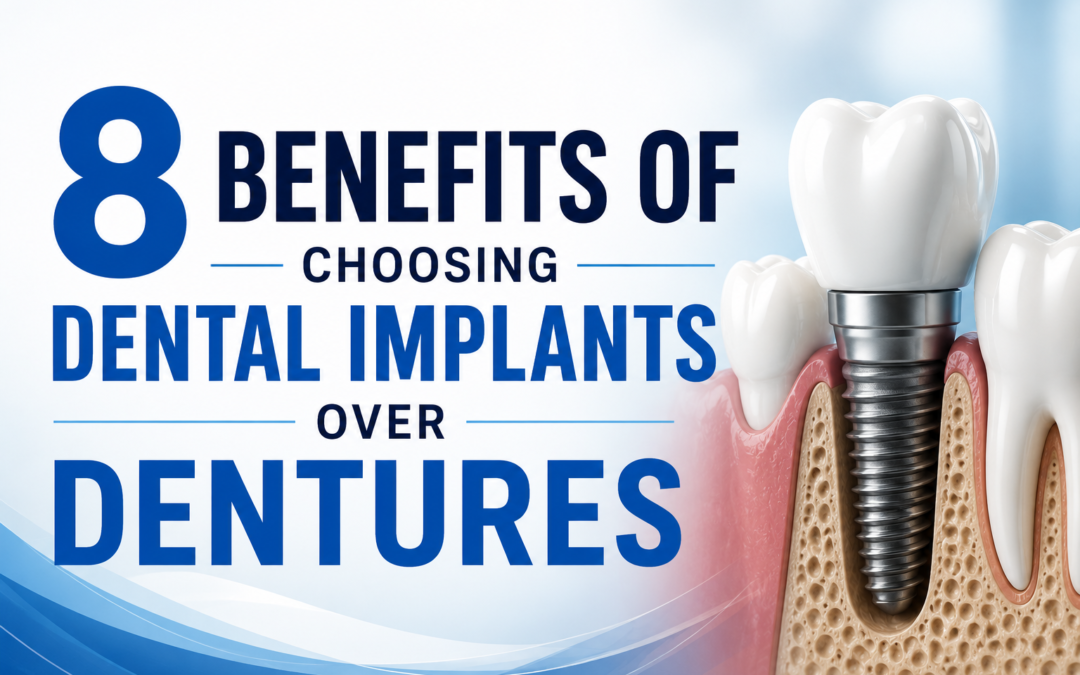
A dental implant is a small post that is surgically placed into the jawbone to replace the function of a missing tooth root. After placement, the implant goes through a healing process called osseointegration, during which the implant bonds with the surrounding bone.
Once the implant has healed appropriately, it can support a dental restoration, such as a crown for a single missing tooth or a larger restoration for multiple missing teeth.
Silverlake Smiles offers several implant options depending on a patient’s needs, including single-tooth implants, multiple implants, implant placement and restoration, and All-on-4® dental implants. The practice also uses technology such as CT imaging and iTero™ digital scanning as part of treatment planning when appropriate.
How Dentures Work
Dentures are removable dental appliances that replace missing teeth and some of the surrounding oral structures. Full dentures can replace an entire arch of missing teeth, while partial dentures can replace several missing teeth when some natural teeth remain.
Unlike dental implants, traditional dentures do not become anchored within the jawbone. They rest on the gums and can be removed for cleaning and other daily routines.
Neither option is automatically right for every patient. Your oral health, jawbone condition, number of missing teeth, treatment goals, budget, and personal preferences can all influence which approach makes sense.
8 Benefits of Choosing Dental Implants Over Dentures
Here are eight potential benefits of choosing dental implants over traditional removable dentures.
1. Dental Implants Are Anchored in the Jawbone
One of the biggest differences between dental implants and traditional dentures is how they are supported.
A dental implant is placed directly into the jawbone, where it can integrate with the surrounding bone during the healing process. This creates a stable foundation for the replacement tooth or restoration attached to it.
Dentures, on the other hand, rest on the gums. Although modern dentures can be carefully fitted to improve their stability, they remain removable appliances.
This distinction can make dental implants appealing to people who want a more secure tooth-replacement option. An implant-supported restoration is anchored in place rather than relying entirely on the shape of the gums for support.
Before recommending an implant, your dentist will need to evaluate your jawbone and overall oral health. Patients with insufficient bone may need additional treatment, such as bone grafting, before implant placement can be considered.
2. They Can Provide Greater Stability When Eating and Speaking
Having a replacement tooth that stays securely in place can make everyday activities feel more natural.
Because dental implants are anchored in the jawbone, they can provide a stable foundation for a replacement tooth. This can help reduce concerns about a restoration shifting during activities such as eating or speaking.
Removable dentures can sometimes move, particularly when the fit changes over time. Changes in the gums and underlying bone following tooth loss can affect how well dentures fit, which may lead to discomfort or movement.
Implant-supported restorations approach tooth replacement differently. Rather than sitting directly on the gums, the restoration receives support from the implant beneath it.
That stability can be especially valuable when replacing teeth involved in chewing. However, the experience varies from person to person, and your dentist can explain what type of stability you can realistically expect based on your specific treatment plan.
For patients exploring dental implants in Silver Lake, a consultation can help determine whether an implant-supported restoration is an appropriate option for their missing teeth.
3. Dental Implants Can Help Preserve Jawbone Structure
Tooth loss can affect the jawbone because the natural tooth root is no longer providing stimulation to the surrounding bone.
Over time, the bone in an area where a tooth has been lost can gradually shrink. This process, known as bone resorption, can affect the shape and volume of the jaw.
Traditional dentures replace the visible portion of missing teeth but do not replace the tooth root. Dental implants are different because the implant post is placed into the jawbone, providing a root-like foundation for the restoration.
The implant’s presence can help maintain stimulation in the surrounding bone and support the preservation of bone structure.
Preserving the jawbone can have implications beyond tooth replacement. Changes in the jaw can affect the fit of removable dentures and contribute to changes in facial appearance over time.
Not everyone will have enough healthy bone for immediate implant placement. A dental evaluation, often including advanced imaging, can help determine the condition of the jawbone and whether additional treatment is needed.
4. They Can Feel More Like Natural Teeth
Another reason patients consider dental implants in Silver Lake is the way implant-supported restorations are integrated into the mouth.
Traditional dentures are removable appliances that sit over the gums. Patients need time to adapt to wearing them, and some may notice the appliance while eating or speaking.
An implant-supported restoration is attached to an implant that has been placed in the jawbone. This secure foundation can allow the replacement tooth to feel more stable during everyday activities.
The restoration can also be customized to complement the surrounding teeth in terms of shape, size, and appearance. This can help create a natural-looking result while restoring the function of a missing tooth.
That does not mean an implant feels exactly the same as a natural tooth. A dental implant does not contain the same nerves and living tissues as a natural tooth. Still, its secure foundation can provide an experience that many patients find more similar to having a fixed tooth than wearing a removable appliance.
Patients considering dental implants in South Pasadena can discuss their aesthetic and functional goals with the Silverlake Smiles team to determine which tooth-replacement approach may be appropriate.
Understanding how implants differ from dentures is an important first step. The next consideration is how those differences can affect daily oral care, tooth replacement options, and long-term maintenance.
5. They Can Make Everyday Oral Care More Convenient
Caring for your replacement teeth is an important part of maintaining your oral health. One potential advantage of dental implants is that implant-supported restorations remain in place instead of requiring removal for daily cleaning.
Traditional dentures need to be removed and cleaned separately. Patients may also need to follow specific instructions for soaking and storing their dentures when they are not being worn.
With dental implants, your oral hygiene routine can be more similar to caring for natural teeth. Brushing, flossing, and regular dental visits remain important for keeping the surrounding gums and remaining teeth healthy.
The exact cleaning routine can depend on the type of implant restoration you receive. Your dentist can recommend appropriate brushing and flossing techniques and explain how to clean around the implant effectively.
Implants still require ongoing care. Good oral hygiene and regular dental appointments can help protect the gums and supporting structures around the implant.
6. They Can Replace a Single Missing Tooth Without Replacing Multiple Teeth
Losing one tooth does not necessarily mean you need a replacement that affects the teeth around it.
A single dental implant can replace one missing tooth by supporting an individual crown. The implant takes the place of the missing tooth root, while the crown replaces the visible portion of the tooth.
Traditional tooth-replacement options may involve a removable partial denture or a dental bridge. A traditional bridge uses neighboring teeth to support the replacement tooth, while a partial denture uses a removable framework.
An implant-supported crown offers another approach. The replacement is supported by the implant itself rather than relying on neighboring teeth for support.
This can make dental implants an appealing option for patients who have lost a single tooth but want a fixed replacement that is independently supported.
The best option depends on factors such as your oral health, the condition of the surrounding teeth, available bone, and your overall treatment goals. A dental examination can help determine which approach is appropriate.
7. Dental Implants Can Offer a Long-Term Tooth Replacement Option
When replacing missing teeth, patients often want to understand how long their chosen solution may last.
Dental implants are intended to provide a long-term foundation for tooth replacement. The implant itself can remain in the jaw for many years when it integrates successfully with the bone and is properly maintained.
However, long-term success is not guaranteed, and the implant and restoration still require ongoing care. Factors such as oral hygiene, gum health, smoking, certain medical conditions, bite forces, and regular dental maintenance can influence the longevity of an implant.
The restoration attached to the implant may also experience normal wear over time and may eventually need repair or replacement.
This makes regular dental visits important even after your implant treatment is complete. Your dentist can monitor the implant, surrounding gums, and restoration and identify potential concerns early.
For patients comparing dental implants vs. dentures, the potential for long-term use is one factor worth discussing. Your dentist can help you understand the expected maintenance and longevity of each option based on your individual circumstances.
8. They Offer Multiple Options for Different Types of Tooth Loss
Not everyone loses teeth in the same way. Some patients may be missing a single tooth, while others may have several missing teeth or require full-arch tooth replacement.
One advantage of dental implants is that they can be incorporated into different treatment approaches depending on the extent of tooth loss.
Your Silver Lake dentist may offer:
- Single-tooth dental implants for individual missing teeth
- Multiple dental implants for patients missing several teeth
- All-on-4® dental implants for full-arch tooth replacement
- Implant placement and restoration
- Bone grafting when additional bone support is needed
This range of options allows treatment to be tailored to the number of missing teeth, the condition of the jawbone, oral health, and the patient’s goals.
For example, someone missing one tooth may need a single implant and crown, while a patient with extensive tooth loss may benefit from an implant-supported full-arch restoration.
A consultation is necessary to determine which approach is appropriate. Your dentist can evaluate your teeth, gums, jawbone, and overall oral health before recommending a treatment plan.
Are Dental Implants Better Than Dentures for Everyone?
Despite the potential benefits, dental implants are not automatically the right choice for every patient. Dentures remain a practical tooth-replacement option for many people, particularly those who may not be candidates for implant surgery or prefer a removable solution.
Implant treatment involves surgery and requires sufficient bone support for successful placement. Patients with significant bone loss may need a bone graft before an implant can be placed. Oral health, gum disease, certain health conditions, smoking habits, and the ability to maintain good oral hygiene can also influence candidacy.
Cost and treatment timeline may also be important considerations. Dentures can typically be provided without implant surgery, while dental implant treatment involves multiple stages and a healing period.
Your dentist may consider several factors before recommending an option, including:
- The number of missing teeth
- The condition of your gums
- Jawbone volume and density
- The health of your remaining teeth
- Your oral hygiene habits
- Your treatment goals
- Your comfort with surgical treatment
- Your budget and timeline
The goal is to find a tooth-replacement solution that fits your oral health needs and personal circumstances rather than choosing an option simply because it is considered more advanced.
What Does the Dental Implant Process Look Like?
Understanding the process can help you know what to expect if you are considering dental implants.
1. Consultation and Evaluation
Treatment begins with an examination of your teeth, gums, and jawbone. Your dentist will discuss your missing teeth, oral health, and goals for treatment.
2. Digital Planning
Advanced dental technology can help your dentist evaluate the treatment area and plan implant placement. Silverlake Smiles uses CT imaging and iTero™ digital scanning as part of its dental technology.
3. Implant Placement
The implant post is surgically placed into the jawbone. A healing period follows, allowing the implant to integrate with the surrounding bone.
4. Restoration
After the appropriate healing period, a customized restoration is attached to the implant. This completes the replacement of the missing tooth or teeth.
5. Follow-Up and Maintenance
Your dentist will monitor the implant and surrounding tissues and provide recommendations for maintaining your oral health and restoration.
Restore Your Smile With Dental Implants at Silverlake Smiles
At Silverlake Smiles, we understand that replacing missing teeth is a personal decision. Our team takes the time to evaluate your oral health, discuss your goals, and help you understand your tooth-replacement options. Dental implants can provide a stable, long-term foundation for replacing one or multiple missing teeth while helping restore the look and function of your smile.
With dental implant services available in Silver Lake, Los Angeles, and South Pasadena, Silverlake Smiles offers personalized treatment to help patients move forward with confidence.
Schedule a consultation with Silverlake Smiles to discuss your needs and find out if dental implants are right for you.
10 FAQs About Dental Implants vs. Dentures
1. Are dental implants better than dentures?
Dental implants offer advantages such as greater stability and jawbone support, but they are not necessarily better for everyone. Your oral health, bone structure, treatment goals, budget, and personal preferences should all be considered.
2. Are dental implants more comfortable than dentures?
Because dental implants are anchored in the jawbone, they can provide greater stability than removable dentures. Comfort varies between patients, so your dentist can explain what you may expect based on your treatment.
3. Do dental implants look more natural than dentures?
Dental implants can support customized restorations designed to complement your natural teeth. Because the replacement is securely anchored, they can also provide a fixed appearance without the visible bulk of some removable appliances.
4. Can dental implants replace a single missing tooth?
Yes. A single dental implant can support an individual crown to replace one missing tooth. This approach allows the replacement tooth to be independently supported rather than relying on neighboring teeth.
5. Can dental implants replace multiple missing teeth?
Yes. Multiple implants can support several replacement teeth or an implant-supported restoration. The appropriate approach depends on how many teeth are missing, your oral health, and the condition of your jawbone.
6. Can I get dental implants if I have bone loss?
Possibly. Patients with insufficient bone may need a bone graft before implant placement. Your dentist can use an examination and appropriate imaging to determine whether you have adequate bone support for treatment.
7. How long do dental implants last?
Dental implants are intended to be a long-term tooth-replacement option, but their longevity varies. Oral hygiene, gum health, lifestyle factors, regular dental care, and the condition of the restoration can all affect how long they last.
8. Do dental implants require special care?
Dental implants require ongoing oral hygiene and professional dental care. You should continue brushing and flossing regularly and attend recommended dental appointments so your dentist can monitor the implant and surrounding tissues.
9. Are dentures still a good option for missing teeth?
Yes. Dentures can be an effective option for many patients. They may be particularly suitable for people who prefer a removable restoration or are not candidates for implant surgery.
10. Where can I get dental implants in Los Angeles or South Pasadena?
Silverlake Smiles provides dental implant treatment at its Silver Lake, Los Angeles, and South Pasadena locations. The practice offers several implant options and can evaluate your oral health and treatment goals to determine which approach may be appropriate.